The Buruji Madrasa: A Lace-Like Gateway to Seljuk Scholarship in Sivas
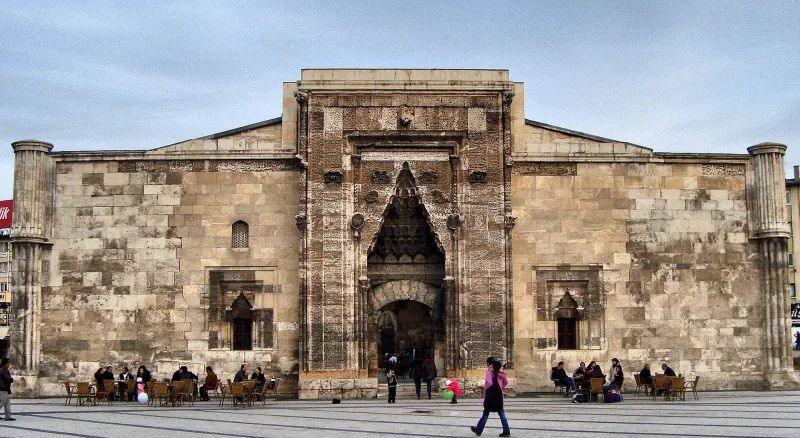
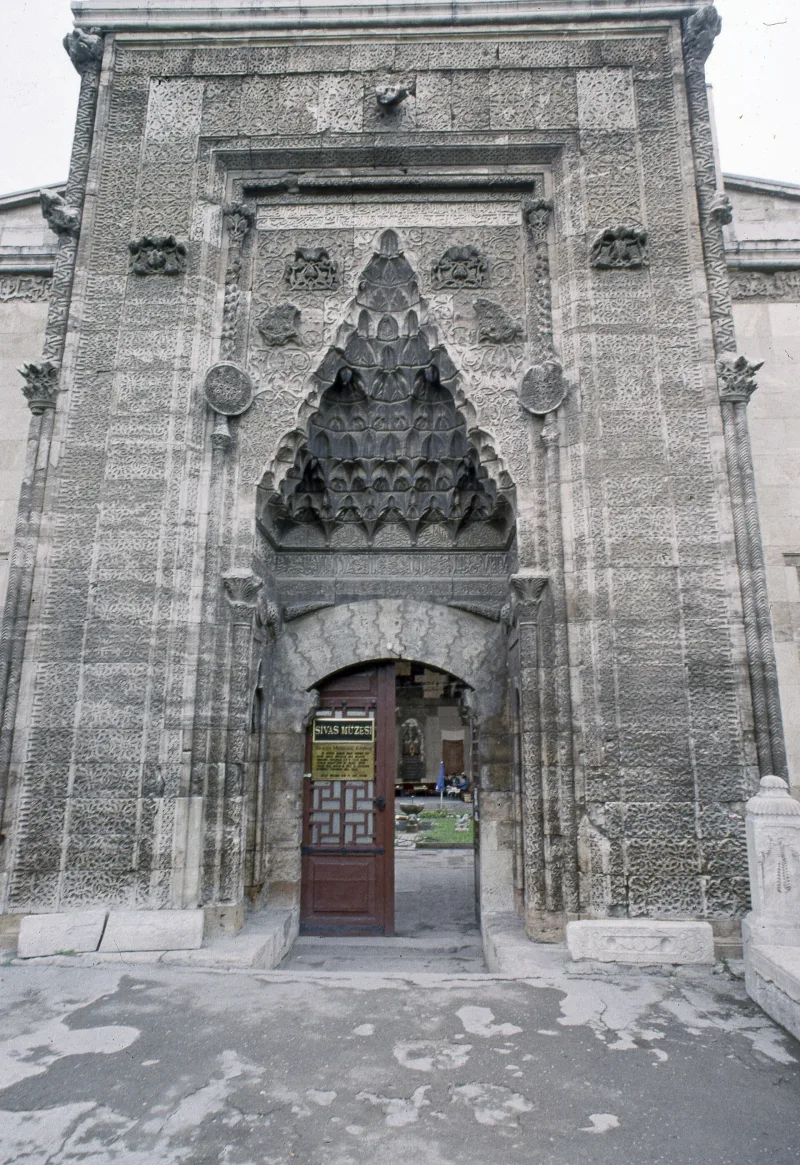
When you step out onto Kent Meydanı, the city square in Sivas, and look up, the portal of the Burujiye Madrasa literally stops you in your tracks: the muqarnas above the entrance hang like a continuous stone lace, with geometric stars and relief spirals covering every inch of the frame. This is not decoration—it is mathematics frozen in stone. The Burujiye Madrasa was built in 1271 during the reign of Seljuk Sultan Giyaseddin Keyhüsrev III, commissioned by Muzaffer Burujerdi—a scholar from the Persian city of Boruj near Hamadan who came to Sivas to teach physics, chemistry, and astronomy. Today, the madrasa serves as a center for religious and cultural education, where calligraphy, ebru, and the art of playing the ney are still taught, and the Quran is recited daily in the mausoleum. Among all the madrasas of Anatolia, this one is a model of symmetry and a quintessential example of Seljuk architecture.
History and Origin of the Burujiye Madrasa
The year is 1271. The Rum Seljuk Sultanate is going through difficult times: Mongol pressure is mounting, and central authority is weakening. But construction continues in Sivas. Muzaffar ibn Ibadullah al-Mufaddal al-Burujirdi—that is the full name of the patron, inscribed on the inscription band of the mausoleum—arrived from Boruj (Persian: Borujerd) near Hamadan in western Iran. He was a scholar familiar with the tradition of Persian madrasas, and he wanted to create a place in Sivas where the “positive sciences”—physics, chemistry, and astronomy—would be taught, what we would now call a faculty of natural sciences.
The madrasa was built in the year 670 AH (1271 CE) during the reign of Ghiyath al-Din Kaykhusrev III (1265–1284). Its location in the Eskikale district, on the town square, next to two other major madrasas—Çifte Minareli and Şifaiye—suggests that this area was the cultural center of medieval Sivas. The three madrasas stand a few hundred meters apart: it is clear that the entire street functioned as a sort of academic town.
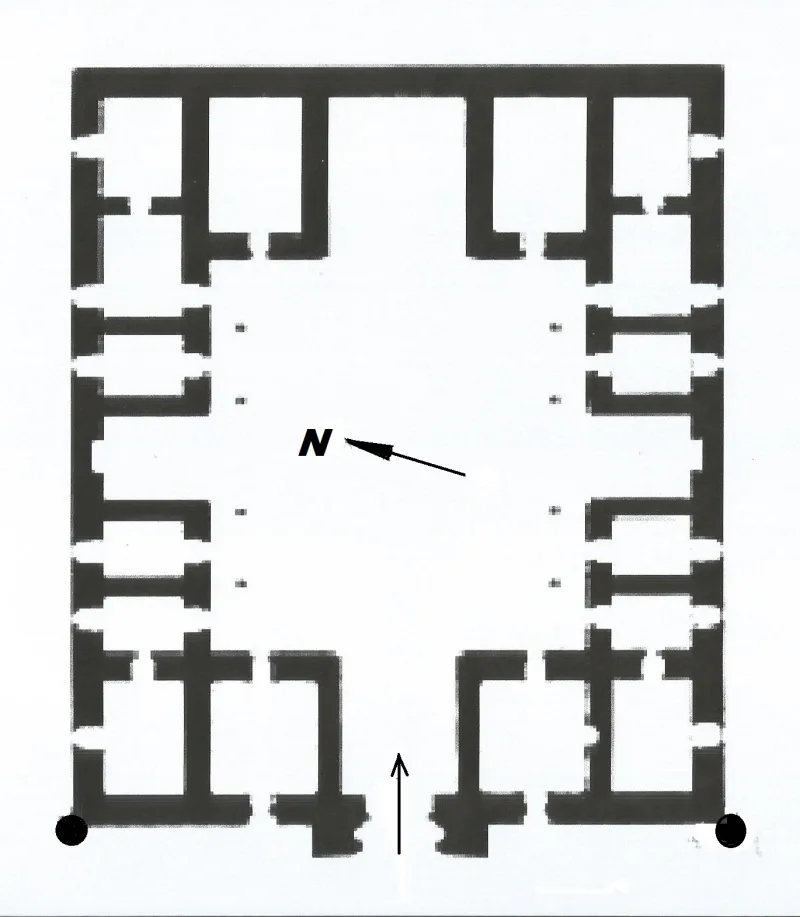
The architect’s name has not been preserved. However, the building clearly follows the tradition of Central Asian Turkic madrasas: four iwans surrounding an open courtyard, a symmetrical plan close to a square. This is no coincidence: the Seljuks came from Central Asia and brought with them this layout, which later spread throughout the Muslim world.
After the madrasa system was abolished in the 1920s, the building stood empty and began to fall into ruin—the mezzanine was completely lost. From 1956 to 1968, a large-scale restoration was carried out: first under the supervision of the Ministry of Education, then under the Ministry of Culture, which took the madrasa under its care in 1957. The mezzanine was restored. In 2005, additional repair work was carried out: the floors were reinforced, the drainage system was repaired, the domes were covered with lead, and the stone pavement was restored. Today, the building belongs to the General Directorate of Waqfs and was transferred to the Sivas Muftiate in 2015. The madrasa has been submitted to UNESCO for consideration as a World Heritage site—the application was included on the tentative list on April 15, 2014.
Architecture and What to See
Architectural historians describe the Buruji Madrasa as “one of the finest examples of Seljuk architecture in Anatolia, featuring the most harmonious and complete architectural elements and ornamentation.” This is no mere rhetoric: the building truly stands out among the madrasas of Sivas for the rigor of its proportions and the meticulousness of its finishes.
Main Portal and Mukarnas
The main entrance is on the west side, facing the street. The portal iwan is decorated with muqarnas that resemble intricate lace: geometric figures inscribed within one another with mathematical precision. The iwan measures 6.50 by 7.80 meters. On either side of the gate are two windows with muqarnas niches and two corner faceted pylons. The portal iwan is surrounded on all sides by inscriptions.
Open courtyard and arcades
Beyond the portal lies an open courtyard with arcades approximately 1.10 meters wide on two sides. The pointed arches of the galleries rest on round columns 270 cm high and about 45 cm in diameter. Some of the capitals are Corinthian, while others bear Byzantine monograms: all of these are “spolia,” that is, stones salvaged from earlier structures. It is a mystery in stone—fragments of several eras within a single arcade.
Eight Study Cells
Eight khujras—living and study cells for students—are arranged around the courtyard. Each opens onto the courtyard through a door but has no windows. The cells behind the narrow arcade are covered by cylindrical vaults. In the cells on either side of the main portal, staircases lead up to the roof, accessing mezzanine rooms with windows.
The mausoleum and tiles
To the left of the main portal is the mausoleum of the patron and his children. Originally, all the walls of the mausoleum were covered with rich hexagonal tiles in blue and black; today, some of the tiles have survived. Along the upper edge of the mausoleum’s walls runs an inscription band bearing the founder’s full name—beneath rows of tiled muqarnas. The Quran is recited here daily, and the sound is broadcast throughout the building via a sound system: visitors can hear the recitation without entering the mausoleum.
Library and Cultural Programs
The waqf (founding document) indicates that the madrasa originally had a library. Today, the building houses two reading rooms, workshops for calligraphy, ebru (marbling), tajwid (melodic recitation of the Quran), Arabic and Turkish language classes, as well as courses on tafsir, hadith, and the ney. Visitors are offered free tea—a kind tradition of Anatolian hospitality.
Interesting Facts and Legends
- The walls of the Buruji Madrasa are between 115 and 150 centimeters thick, depending on their location: this is not merely a construction technique, but a direct legacy of the tradition of Central Asian madrasas, where thick walls provided protection from the summer heat and winter cold.
- Some of the column capitals in the courtyard arcades are Corinthian, clearly brought from older ruins. Others bear Byzantine monograms. Thus, three architectural eras coexist within a single madrasa: Antiquity, Byzantium, and Seljuk Islam.
- In the patron’s mausoleum, Quran reciters rotate daily—a new religious official each day. The sound is broadcast throughout the building via speakers, and visitors to the madrasa can hear the recitation wherever they are. For non-Muslim tourists, this is an unusual and memorable experience.
- The madrasa has been on UNESCO’s tentative list since 2014—along with Çifte Minareli and Şifaiye as part of the “cultural quarter” complex of Sivas. If the nomination is successful, the entire historic city center will receive protected status.
- Among the madrasas of Anatolia, Burujiye stands out for the most precise symmetry of its layout. Experts explain this by the fact that the patron—a natural scientist from Iran—deliberately reproduced the ideal plan of a Central Asian madrasa with four iwans, rather than adapting it to local conditions.
How to get there
The Burujiye Madrasa is located on Kent Meydanı Square in the Eskikale neighborhood of Sivas’s central district. The nearest airport is Sivas Nuri Demirağ (VAS), which receives flights from Istanbul (IST and SAW) and Ankara. The flight time from Istanbul is about 1 hour and 20 minutes. From the airport to the center of Sivas, take a taxi or city bus; the trip takes about 15–20 minutes.
From Ankara, you can travel by train: Ankara Gar Station to Sivas, with a travel time of about 5–6 hours on a regular TCDD train. Bus companies (Metro, Kamil Koç, and others) operate daily routes from Ankara and Istanbul to Sivas. In Sivas itself, all three historic madrasas—Burujiye, Çifte Minareli, and Şifaiye—are located on the same square, Kent Meydanı, within walking distance of each other: you can visit all three in a single day.
Tips for travelers
The Buruciye Madrasa is open daily, and admission is free. Staff will offer you tea—don’t refuse: it’s part of the tradition of hospitality. Inside, please remain quiet, especially during Quran recitations in the mausoleum.
The best time to photograph the facade is in the morning, when the sun shines directly into the portal and the muqarnas cast deep shadows. The evening lighting is warm but loses the sense of depth. Plan to spend at least 45–60 minutes at the Burujiye Madrasa, and if you want to see all three madrasas in the neighborhood, allow half a day. In Sivas itself, there are several good hotels in the center; the city is small and convenient for independent travel.
Combine your visit with the Çifte Minareli Medrese (the Two-Minaret Medrese—the city’s most photogenic site) and the Şifaiye Medresesi (a 13th-century hospital medrese)—all three are within a hundred meters of each other. The 12th-century Ulu Camii Grand Mosque is also located just two blocks away. For lovers of Seljuk architecture, Sivas is a must-see stop on the route between Ankara and Erzurum. Visit in spring (April–May) or early fall (September–October): summers here are hot and dry, and winters are harsh. It is during the mild off-season that the portal of the Buruji Madrasa is best appreciated—each muqarnas pattern, bathed in the soft Anatolian light, looks like a separate masterpiece of applied art.